Extreme Scale Efficacy
We train decoder-only µLMs in the 8.8M–29.5M range and show that useful short response generation survives at this extreme scale.
1Paul G. Allen School of Computer Science & Engineering, University of Washington 2Meta AI
EMNLP 2026 Main Conference (Oral)
Edge devices such as smartwatches and smart glasses cannot continuously run even the smallest 100M–1B parameter language models due to power and compute constraints, yet cloud inference introduces multi-second latencies that break the illusion of a responsive assistant. We introduce micro language models (µLMs): ultra-compact models (8M–30M parameters) that instantly generate the first 4-8 words of a contextually grounded response on-device, while a cloud model completes it; thus, masking the cloud latency. We show that useful language generation survives at this extreme scale with our models matching several 70M–256M-class existing models. We design a collaborative generation framework that reframes the cloud model as a continuator rather than a respondent, achieving seamless mid-sentence handoffs and structured graceful recovery via three error correction methods when the local opener goes wrong. Empirical results show that µLMs can initiate responses that larger models complete seamlessly, demonstrating that orders-of-magnitude asymmetric collaboration is achievable and unlocking responsive AI for extremely resource-constrained devices.
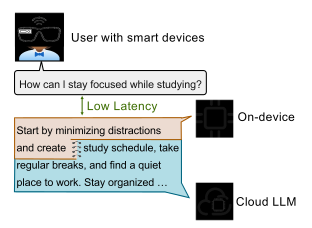
We train decoder-only µLMs in the 8.8M–29.5M range and show that useful short response generation survives at this extreme scale.
We reframe the cloud model as a continuator, enabling seamless mid-sentence handoff after a short on-device opener.
We design three recovery modes—Explicit correction, Natural recovery, and Humor-aware recovery—to handle imperfect local prefixes.
Model checkpoint: Swen-28M
If our idea inspires your work, welcome cite:
@misc{cheng2026microlanguagemodelsenable,
  title        = {Micro Language Models Enable Instant Responses},
  author       = {Wen Cheng and Tuochao Chen and Karim Helwani and
                  Sriram Srinivasan and Luke Zettlemoyer and Shyamnath Gollakota},
  year         = {2026},
  eprint       = {2604.19642},
  archivePrefix= {arXiv},
  primaryClass = {cs.CL},
  url          = {https://arxiv.org/abs/2604.19642}
}